
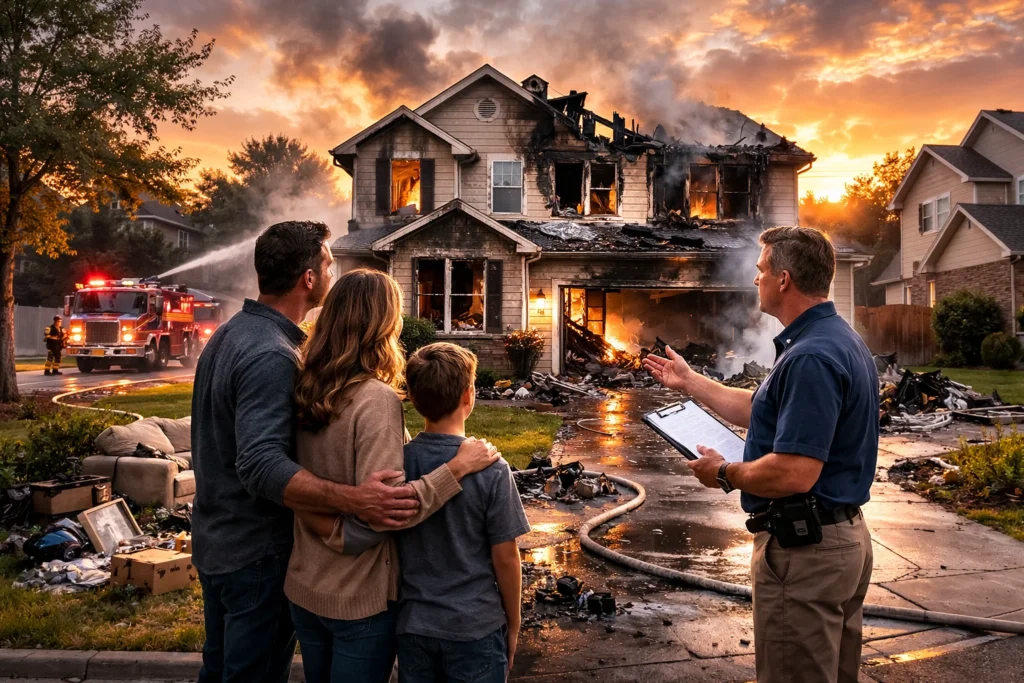
A house fire changes everything in minutes. And when the smoke clears, most homeowners in McKinney realize they are not just dealing with damage — they are navigating a complicated insurance system that moves fast and speaks a language few people truly understand. This is exactly when a fire insurance public adjuster becomes critical.
I’ve seen it again and again. The fire department leaves. The shock sets in. The insurance company calls. And suddenly you’re expected to make major financial decisions while still processing what just happened.
Let’s slow this down. Let’s talk about what really happens after a fire in McKinney, Texas — and how a fire insurance public adjuster protects your side of the table.
When the Fire Trucks Leave
The first 24 hours are chaos.
You’re securing the property. Finding temporary housing. Calling family. Trying to salvage personal belongings. Everything feels urgent.
Then the insurance claim begins.
Here’s what typically happens:
- You report the claim.
- The insurance company assigns an adjuster.
- An inspection is scheduled.
- You’re asked for documentation, photos, and an inventory of damaged items.
It sounds straightforward. It isn’t.
Fire claims are among the most complex property claims filed in Texas. They involve structural damage, smoke contamination, water damage from suppression, code upgrades, and personal property valuation — all layered together.
And remember this clearly: the insurance company’s adjuster works for the insurance company.
A fire insurance public adjuster works for you.
That distinction changes everything.
What Is a Fire Insurance Public Adjuster?
A fire insurance public adjuster is a licensed professional who represents policyholders — not carriers — during an insurance claim.
We:
- Review your policy in detail.
- Document and estimate every category of damage.
- Prepare a complete claim package.
- Negotiate directly with the insurance company.
- Maximize the settlement under your policy terms.
We are paid on contingency. That means we are compensated from the settlement — not upfront. If we don’t improve or resolve your claim, we don’t get paid.
Simple. Aligned incentives.
Why Fire Claims Are So Complex
Fire doesn’t just burn. It contaminates.
Let’s break down the layers.
1. Structural Damage
Obvious burns are only part of the story.
Heat weakens framing.
Electrical wiring melts.
HVAC systems draw smoke throughout the house.
Roof decking may be compromised.
Some damage is visible. Much of it is hidden.
2. Smoke and Soot
Smoke travels everywhere. It seeps into insulation, cabinets, ductwork, and drywall cavities.
If not properly addressed, smoke odor can linger for years.
Insurance companies sometimes scope smoke remediation narrowly. That’s where experienced documentation matters.
3. Water Damage from Fire Suppression
Thousands of gallons of water may have been used to extinguish the fire.
That means:
- Soaked insulation
- Swollen subfloors
- Mold risk
- Secondary structural issues
It becomes both a fire claim and a water damage claim.
4. Personal Property Loss
This is where most settlements fall short.
Homeowners are often asked to list and value every item they owned. Clothing. Kitchen utensils. Garage tools. Electronics. Furniture.
It’s exhausting.
And without a systematic inventory process, thousands of dollars can disappear from the claim.
Where Fire Insurance Claims Go Wrong in McKinney
McKinney has grown rapidly. Construction costs in Collin County have increased significantly in recent years. Labor shortages and material pricing fluctuations have pushed rebuild estimates higher than many carriers initially expect.
Common claim problems include:
- Underestimated rebuilding costs
- Missed code upgrade coverage
- Low personal property valuations
- Partial smoke remediation approvals
- Delays in Additional Living Expense (ALE) payments
- Depreciation disputes
When these issues pile up, the financial gap becomes serious.
This is when hiring a fire insurance public adjuster early makes a measurable difference.
How a Fire Insurance Public Adjuster Maximizes Your Settlement
Let’s get practical. What do we actually do?
Policy Analysis First
Most homeowners have never read their full policy.
We review:
- Dwelling coverage limits
- Personal property coverage
- Additional Living Expenses (ALE)
- Ordinance & law coverage
- Debris removal
- Code upgrade endorsements
Understanding coverage is step one. Without that, negotiations are guesswork.
Detailed Damage Documentation
We don’t rely on a quick walkthrough.
We build:
- Line-item Xactimate estimates
- Photographic documentation
- Structural measurements
- Contents inventories with valuation research
- Smoke mapping documentation
Fire claims are won on documentation. Not emotion.
Negotiation Strategy
Insurance companies negotiate based on numbers and policy language.
We respond with:
- Comparable contractor estimates
- Market pricing in McKinney
- Engineering assessments (if needed)
- Formal rebuttals to low offers
- Supplemental claims when additional damage is found
A fire insurance public adjuster understands how to present numbers in a way carriers must address.
Fire Claims vs. Other Property Claims
Fire claims are layered. Let’s compare.
| Claim Type | Complexity Level | Hidden Damage Risk | Contents Impact |
| Roof Storm Damage | Moderate | Low | Minimal |
| Water Leak | Moderate | Moderate | Limited |
| Fire Damage | High | Very High | Extensive |
Fire damage touches every system in the home.
That’s why the average fire claim is significantly larger — and more disputed — than typical storm claims.
Signs You Should Hire a Fire Insurance Public Adjuster Immediately
You don’t always need one. But here are strong indicators:
- Your home suffered major structural damage.
- The settlement offer feels low.
- The claim is delayed without explanation.
- You received a partial denial.
- You are overwhelmed by documentation.
- The loss exceeds six figures.
Even if you’ve already started the claim, it’s not too late.
Mistakes McKinney Homeowners Make After a Fire
I’ll be direct here.
1. Accepting the First Offer
Initial offers are rarely the final numbers.
2. Throwing Away Damaged Items Too Soon
Documentation must come first.
3. Starting Repairs Before Full Scope Approval
This can complicate negotiations.
4. Underestimating Rebuild Costs
McKinney construction pricing isn’t what it was five years ago.
5. Not Tracking Additional Living Expenses
Hotels. Meals. Mileage. Storage. It adds up.
If ALE tracking isn’t organized, reimbursements shrink.
The Local Advantage: Why McKinney Matters
Insurance is national. Construction is local.
Hiring a McKinney-based fire insurance public adjuster means:
- Knowledge of Collin County permitting
- Familiarity with local contractor pricing
- Understanding of regional code enforcement
- Faster on-site inspections
- Direct relationships with remediation specialists
Local knowledge strengthens negotiations.
The Step-by-Step Process When You Hire Us
Here’s exactly how it works:
Step 1: Free Consultation
We evaluate the loss and review your current claim status.
Step 2: Policy Review
We identify all available coverages.
Step 3: On-Site Inspection
Thorough structural and smoke evaluation.
Step 4: Documentation & Estimating
Full claim package preparation.
Step 5: Negotiation
Direct communication with the carrier’s adjuster.
Step 6: Settlement Resolution
Final agreement and disbursement.
Structured. Organized. Transparent.
A Realistic Example
A recent North Texas fire loss (anonymized) involved:
- 2,800 sq ft home
- Kitchen fire with heavy smoke spread
- Initial carrier estimate: $187,000
- Final negotiated settlement: $312,000
The difference came from:
- Full smoke remediation scope
- Code upgrade coverage
- HVAC replacement
- Correct personal property valuation
- Supplemental water damage findings
That’s not unusual. It’s documentation-driven.
Frequently Asked Questions
Typically a percentage of the settlement. No upfront fees.
No. A public adjuster can step in mid-claim.
No. You have the legal right to representation in Texas.
Major fire claims can take several months depending on scope and negotiation.
Yes. Total losses require even more documentation and policy analysis.
Smoke claims can be substantial and often under-scoped.
In some cases, yes — depending on timelines and policy terms.
Yes. Texas licensing is required to act as a public adjuster.
Protect What You’re Owed
A house fire is traumatic. The insurance process should not add more stress.
Insurance companies protect their bottom line. That’s their model.
A fire insurance public adjuster protects yours.
If you’re dealing with a fire damage claim in McKinney or anywhere in Collin County, don’t navigate it alone. Get clarity. Get documentation. And get leverage.
And then move forward with confidence.